Young Men Are Losing Their Footing
Disillusionment Has Become a Business Model.
A large portion of young men are struggling across several areas. They are arriving at adulthood with weaker educational credentials, low economic prospects, low emotional ability and appetite for support, low interest in civic participation, and, importantly, a low opinion of male worth and their place in society.
EXECUTIVE SUMMARY
These compounding issues are unfolding at the exact moment digital culture has become exceptionally good at monetizing insecurity. The manosphere did not invent this instability; it recognized it and, with the timely arrival of algorithmic media, packaged it and sold it back as identity, certainty, status, belonging, and potential. We now have a mature, glossy marketplace that treats young men as a revenue stream, leaving society to pick up the pieces.
Education
Boys fall behind girls early, and the gap widens over time. In developed countries, girls now outperform boys across much of formal education and are more likely to complete post-secondary study, leaving many young men less prepared for credential-driven work. That matters because the modern economy increasingly rewards organization, verbal fluency, and long-range planning, traits school systems tend to measure and reinforce. The result is not just weaker academic performance, but a weaker sense of relevance that now shapes entry into adult life. (oecd.org)
Economics
The economy in which many boys were once raised has shrunk. Manufacturing, extraction, and other traditionally male sectors no longer offer the same volume of stable, identity-forming work, while newer roles increasingly reward credentials, communication, and service-oriented skills. Many young men are therefore entering adulthood with fewer obvious pathways into competence, income, and status. This is not simply about employment. It is about the erosion of culturally legible work that once gave men a clear place in society and a believable route into self-respect. (centreforsocialjustice.org.uk)
Emotion Control
Many boys are still socialized to suppress vulnerability rather than understand it. That leaves too many young men less emotionally literate, less able to form trusting relationships, regulate stress, or move through difficulty without avoidance, aggression or stimulants. It also helps explain why they are less likely to seek support and more likely to see help as weakness. The issue is not that young men do not feel deeply. It is that many have not been given the tools, language, or permission to process distress before it hardens into isolation, anger, or self-destruction.
Culture
Gender roles have changed dramatically, but society has done a poor job of defining a persuasive modern role for young men within that change. Women have been encouraged, rightly, to expand into education, work, and public life. Young men, by contrast, have often been told what not to be without being shown what to become. That ambiguity creates a vacuum. For some, it produces confusion and drift. For others, it creates an opening for older, more hierarchical ideas about masculinity, authority, and worth to return dressed up as clarity. (kcl.ac.uk)

Algorithmic Media
Algorithmic media has intensified all of this by feeding young men emotionally charged, idealized, and often false narratives about power, women, success, and society. What begins as fitness, confidence, or self-improvement content can quickly become a funnel into grievance, misogyny, and status obsession. These systems do not merely reflect male uncertainty; they amplify it, shape it, and monetize it. A generation of young men is now being sold certainty, identity, and belonging through content ecosystems that often profit directly from insecurity, alienation, and distrust of the mainstream. (ofcom.org.uk) (ucl.ac.uk)
4X
Men in the US die by suicide at four times the rate of women. u003ca href=u0022https://www.cdc.gov/suicide/facts/data.htmlu0022 type=u0022linku0022 id=u0022https://www.cdc.gov/suicide/facts/data.html?utm_source=chatgpt.comu0022u003eSourceu003c/au003e.
+29%
Across the OECD, women are now more likely than men to complete higher education. u003ca href=u0022https://www.oecd.org/en/publications/2025/09/education-at-a-glance-2025_c58fc9ae/full-report/to-what-level-have-adults-studied_c1d483b0.htmlu0022u003eSourceu003c/au003e.
Author:
Chris Neary
Published:
Understanding the true nature of the problem facing young men is pivotal to ideating a solution. Research first.
Chris Neary – Frank Strategy
FULL ARTICLE
Economics – Good work is a prosperity magnet.
Scott Galloway has been especially effective at naming the economic layer with unusual bluntness. His point is simple and persuasive: when young men cannot see a credible route to competence, income, and status, the damage does not stop at the pay cheque. It spills into self-respect, relational confidence, and civic conduct. That argument aligns with a broader structural reality.
The post-industrial economy has narrowed the number of broad-based, socially legible paths into adulthood for men with weak credentials. Male-dominated industries such as manufacturing, agriculture, and construction accounted for more than 40 percent of UK output in 1970, but just 16 percent in 2023. This decline of male-dominated sectors, combined with the growing premium placed on qualifications and soft skills, has reduced the number of roles that reliably confer stability, identity, and pride. The issue is not that jobs no longer exist. It is that the jobs that remain are less likely to offer the cultural solidity that older male pathways once did.
Prof. Galloway also has some uncomfortable theories about the relevance of economic prospects to a man’s ability to attract a partner. He argues that women, when looking for a partner, are interested in the prospect’s economic viability, as it determines his ability to contribute to a comfortable, risk-free environment for family life. Debatable, but if true, it means that low economic opportunities will vastly decrease a man’s ability to find a partner.

Emotions – Low emotional literacy limits growth.
Men are less likely to seek help for mental-health problems, even when the need is obvious. It takes around 11 years for a man to arrive in a counselling clinic. Men commit suicide at four times the rate of women, and approximately 92% of the North American prison population is male at the time of writing. Gallup states 25% of U.S. men under 35 reported feeling lonely. Loneliness is strongly associated with depression and anxiety, especially among younger adults. Among younger men, loneliness is a marker for vulnerability to influences like looksmaxxing, incel, and other branches of the manosphere.
A recent systematic review found recurring barriers centred on masculine norms, self-stigma, limited mental-health literacy, and poor fit between services and male help-seeking patterns. That finding sits alongside broader reviews showing that men often delay care because seeking help is experienced as weakness, dependency, or loss of face. They are also more likely to view health care as a place for acute or physical problems, rather than a routine setting for emotional support or preventive mental health care.
The issue, then, is not just access. It is identity. Can a young man imagine himself as the kind of person who asks for help without feeling diminished by the act? For too many, the answer appears to be no. That is why service design matters. Not because men deserve indulgence, but because many systems still fail to recognize how distress is actually disclosed by boys and young men.

-24%
Male-dominated industries such as manufacturing, agriculture, and construction accounted for more than 40 percent of UK output in 1970, but just 16 percent in 2023. u003ca href=u0022https://www.centreforsocialjustice.org.uk/wp-content/uploads/2025/03/CSJ-The_Lost_Boys.pdfu0022 type=u0022linku0022 id=u0022https://www.centreforsocialjustice.org.uk/wp-content/uploads/2025/03/CSJ-The_Lost_Boys.pdfu0022u003eSource.u003c/au003eu003cbru003e
Culture – Manhood now lacks definition.
As women have advanced in education, work, and public life, and as gender roles more broadly have been redesigned, many of the old roles that once gave men a clear sense of status and purpose have disappeared. For a minority of young men, that instability appears to be producing a defensive turn toward hierarchy. King’s College London’s March 2026 polling suggests this is now visible in the data, with 31 percent of Gen Z men agreeing that a wife should always obey her husband, and 33 percent saying a husband should have the final say on important decisions. That is not the majority view, but it is large enough to show that traditional authority-based ideas are finding traction.
This should not be read as old-fashioned sexism simply resurfacing unchanged. It is also a consequence of transition. Public debate has spent decades, rightly, expanding the language around women’s rights, opportunity, and empowerment, but it has been less effective at articulating a persuasive modern account of male identity that feels substantive without slipping back into patriarchy. With fatherless family rates increasing and with some pop culture icons behaving in anti-social and unhealthy ways, young men are likely finding it hard to connect with people and movements that have the answers. In that vacuum, some young men become receptive to narratives that cast them as newly displaced, newly ignored, or newly wronged – which is the first stage of onboarding into the manosphere.

Digital – So good it’s unreal.
Algorithmic media has intensified all of this by feeding young men emotionally charged, idealized, and often false narratives about power, women, success, and society. What begins as fitness, confidence, or self-improvement content can quickly become a funnel into grievance, misogyny, and status obsession. These systems do not merely reflect male uncertainty; they amplify it, shape it, and monetize it. A generation of young men is now being sold certainty, identity, and belonging through content ecosystems that often profit directly from insecurity, alienation, and distrust of the mainstream.
This is especially potent because it has emerged at a moment when many boys are less anchored by fathers, mentors, and real-world male relationships than previous generations. The Lost Boys report notes that boys are now more likely to own a smartphone than to live with their dad, which captures the broader substitution taking place: guidance once expected from real people is increasingly being outsourced to digital personalities and algorithmic feeds.
The manosphere is best understood as a by-product of that wider loss of traction. It exists because the underlying problems are real: educational drift, economic uncertainty, weak emotional resilience, poor relationship skills, and a lack of social role, and because digital media is perfectly designed to exploit them. Even pornography can function within that same system, offering some young men a low-risk substitute for intimacy that avoids refusal, vulnerability, and the development of real social confidence.

Where is this all going?
Where this is going is increasingly clear. These are not separate pressures but compounding ones. Boys fall behind in education, enter a weaker labour market, struggle to build confidence and relationships, and do so in a culture that has disrupted old roles without offering a convincing new one.
That layered instability has created the perfect conditions for algorithmic media and influencer culture to step in. What has emerged is a counterculture built on recognizing real male dislocation, then reframing it in ways that are emotionally seductive, commercially profitable, and socially corrosive. In other words, a generation of male uncertainty is being turned into a business model, for private gain and public cost.
Not all young men are choosing this route, but millions are.
What is the Manosphere?
The manosphere is an ecosystem of self-improvement economies like looksmaxxing, biohackers, incels, pickup artists, red pill, black pill, MGTOW and more. It’s a mature set of ideologies that has traction in popular culture in most developed countries, specifically in teenage boys and young men.
These spaces start the recruitment process by recognizing real issues and the pain they cause in young men. You are behind in life. You are overlooked. You have no voice. You’re unattractive to women. Institutions abuse you. You have no place in the world. Those feelings are recognizable and comforting.
Then comes the system explanation. The pain is reorganized into a total theory. Feminism rigged culture. Politicians are scheming to remove men’s rights. Women are hypergamous sluts. Institutions are preparing you for consumption. Mainstream life is a trap. For a lonely, poorly educated, emotionally stunted young man in pain, all this can feel like a revelation and provide hope.
Then comes the prescription, often presenting the influencer as proof. Build wealth. Build muscle. Harden yourself. Reject softness. Master women. Leave the system. The message is not merely ‘improve yourself’. It is ‘improve yourself so you stop being the loser in a rigged hierarchy’.
Then comes monetization. Once the identity problem has been named and dramatized, commercial pathways open quickly. Courses, private groups, supplements, testosterone products, investment opportunities, coaching, affiliate links, paid networking communities.
Disillusionment is now a product. Young men’s insecurity, isolation, and uncertainty have become raw material for a digital economy that sells certainty, identity, and belonging. The manosphere is not just a set of ideas. It is a market built to profit from male instability.

The Incel Movement.
The incel movement is often summarised as involuntary celibacy, but that misses the point. In practice, it offers a total theory of social worth. It tells men that attractiveness, genetics, and market value determine almost everything, including romantic access, self-respect, and social visibility. That is why it feels so totalizing. Romantic failure is not presented as a difficult experience. It is presented as proof of inferiority. (pmc.ncbi.nlm.nih.gov)
This might explain its overlap with looksmaxxing and other aspects of the manosphere. Once the self is reduced to a low market value, the body becomes a repair project, with biohacking and aesthetic manipulation as obvious next steps.
Looksmaxxing
Looksmaxxing is one of the clearest signs that the problem is not just ideological but aesthetic. The pursuit of physical optimization is framed as a route to ‘ascension’ in sexual and social status. (journals.sagepub.com)
Ironically, in this manly pursuit, young men are now being taught to assess jawlines, skin, hairlines, height, body composition, and hormonal status with a level of scrutiny historically more associated with women’s beauty cultures. Oddly, this ideology creates a harsh framework of ranking, humiliation, and sexual competition among men. (journals.sagepub.com)
The same dynamic is visible in the testosterone and biohacking economy. Ordinary uncertainty, fatigue, or emotional flatness can be recoded as biochemical weakness requiring expensive correction. Not all optimization culture is fraudulent. But some of it is clearly exploiting male insecurity under the guise of science, performance, and mastery. (theguardian.com)
Red pill, black pill, and MGTOW
Red pill, black pill, and MGTOW are different expressions of the same deeper mood: male disillusionment reorganized into ideology. While fewer in numbers, these spaces have a legitimate place online and in the minds of young men.
Red pill communities frame themselves as an awakening, teaching men that the official story about women, equality, and modern relationships is a lie. Black pill spaces turn that cynicism into fatalism, arguing that biology, looks, and status determine everything, leaving many men with no meaningful chance of intimacy. MGTOW offers a different answer again, urging men to withdraw from women, marriage, and mainstream social expectations altogether.
What unites all three is the claim that modern life has become structurally hostile to men, and that hierarchy, detachment, or despair are more rational than trust. These are not random internet eccentricities. They are highly contemporary responses to a real loss of traction in the lives of some young men, then sharpened and scaled by algorithmic media into emotionally powerful, commercially useful worldviews. (ofcom.org.uk) (tandfonline.com)
CONCLUSIONS
Young men have not suddenly become fragile. Nor has feminism somehow broken them. What appears to be happening is that a sizable number of young men are reaching adulthood with weaker credentials, limited emotional vocabulary, lower job prospects, less connection to society, and less willingness to engage socially than earlier generations. At the same time, algorithmic media and content creators have become remarkably efficient at monetizing disenfranchised people. It is one of the things the system now produces when its failures are left to the market to explain.
The manosphere is best understood not only as an ideology but as a market. It positions itself against distrusted institutions, offers a total explanation, and sells escalation paths. In commercial terms, it is efficient. In social terms, it is deeply corrosive.
The reason for the manosphere’s success is not because it has discovered a profound new truth about men. It is succeeding because too many young men feel educationally uncertain, economically peripheral, emotionally unsupported, and socially unclaimed, and because in an attention economy, certainty will usually outperform nuance unless better institutions, better narratives, and better forms of belonging arrive first.

Citations:
If You Liked That, You’ll Love This…
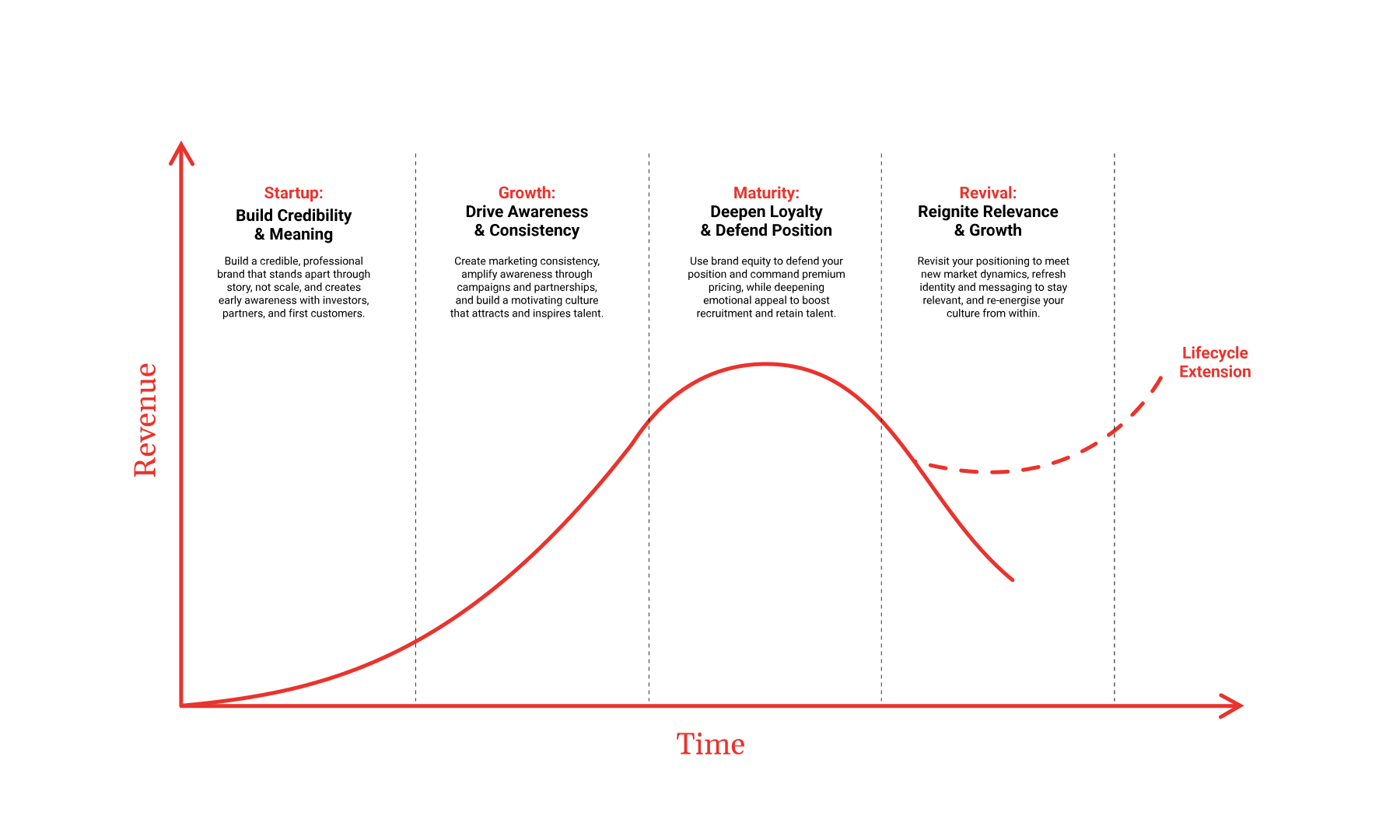
Branding has a different role at every stage of the business lifecycle. Put your money where it matters most.
Excluding exceptions like turnarounds or mergers, most businesses move through four stages: Startup, Growth, Maturity, Revival. Like any other business lever, branding contributes differently at each stage of that evolution. A smart brand investment for a company in Growth won’t deliver the same ROI for one in Startup or Decline. Working with a brand agency…

A Brand Strategist.
This article first appeared in Marketing Magazine in 2016. Our Founder, Chris Neary, offers insight into the role of a Brand Strategist in a competitive marketplace.

The Top Ten Ways a Brand Benefits Your Business
There’s a significant difference between a business and a brand. Brands consistently outperform businesses across all metrics. If your business lacks a brand, you’re just a supplier.