BRANDING FOR DIFFERENT STAGES OF BUSINESS GROWTH
Stop buying branding services that solve last year’s problems.
Most businesses move through four stages: startup, growth, maturity, and revival. Each stage creates different constraints, and your brand has a different job to do in response.
INTRODUCTION
If you buy the wrong kind of branding for your stage, you will get the classic result: a prettier business that performs the same. This article outlines what branding for different stages of business growth entails, what to measure, and which services are worth paying for.
Brand projects are usually initiated within marketing, treated as a cost centre, and judged as a design exercise. That mindset quietly sabotages the outcome. Brand is a commercial lever that shapes preference, pricing power, loyalty, recruitment, and the efficiency of marketing conversion. When you match branding to your business stage, three useful things happen:
- You stop buying ‘brand stuff’ and start buying outcomes.
- You reduce marketing waste by creating clarity, consistency, and focus.
- You give leadership a shared decision framework, so the organization stops freelancing.
This is also why the best brand work is initiated by senior leadership, distributed across the organization, and measured for ROI, not admired in a slide deck.
90%
Intangible assets, like brand, represent over 90% of S&P 500 market value.
42%
In startup failure postmortems, ‘no market need’ is cited in 42% of cases, many of which didn’t earn prospect relevance at the brand level.
Author:
Chris Neary
Published:
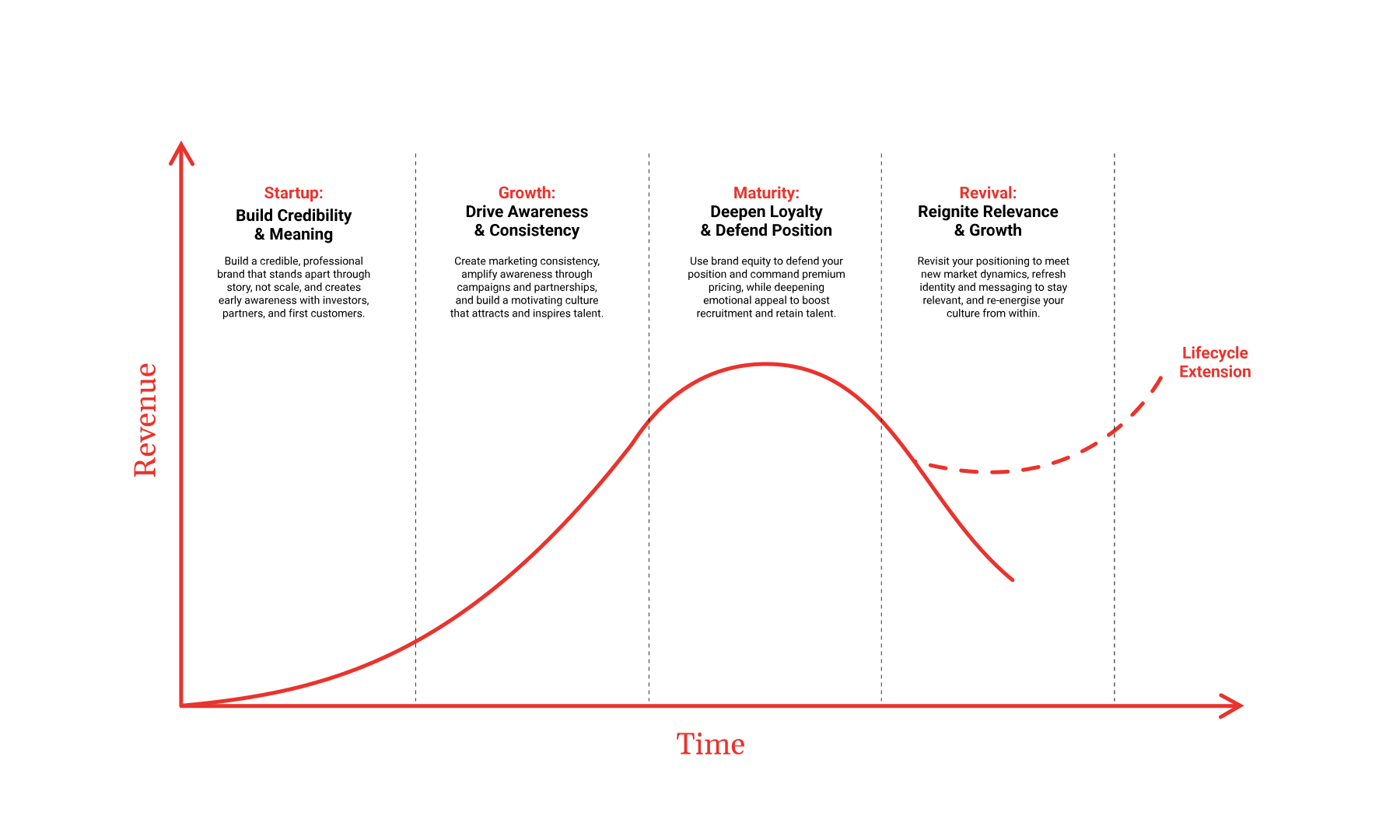
Most brand spend turns into a cost centre because it solves the wrong problems. Startup needs credibility, growth needs consistency, maturity needs loyalty, revival needs relevance.
Branding for different stages of business growth.
The Brand’s Job at Each of the Four Stages.
1) Startup: Create Credibility & Establish Meaning
What’s happening in the business?
High uncertainty, low awareness, and a lot of selling by explanation. You are trying to earn the right to be taken seriously by customers, talent, partners, and sometimes investors.
Businesses in Startup Stage – The brand’s job.
Branding services aimed at early-stage businesses typically centre on defining the audience, problem, and differentiation, and on building a foundational visual and verbal identity that creates relevance within a defined market. Create credibility quickly and make the business legible. Your brand must clarify:
- What you do
- Who do you exist for
- Why you are relevant
- Why anyone should trust you
- How you differ from your peers
Startup Branding – What to buy, and what to avoid.
Buy:
- A brand strategy that is closely aligned with your business goals.
- Brand research that determines real demand, willingness to pay, and category expectations.
- Brand positioning that enables you to stand out from the market and own a space.
- Key messaging that sales, founders, investors, and marketing can use consistently.
- Brand Identity that makes you look and sound well-established and trustworthy.
Avoid:
- Over-investing in polish before the story is clear. Test & refine as you go.
- Big, expensive identity systems designed for an organization you have not yet become.
- Guesswork that disables you from connecting on a real level with your prospects. RESEARCH.
Startup stage Branding – What to measure.
Track trust signals, referrals, and partner interest, then watch what happens to sales cycle length, win rate, and inbound lead quality. Finally, measure message pull-through. Can prospects repeat your story back to you accurately, without coaching?

2) Growth: Drive Awareness & Enforce Consistency
What’s happening in the business?
Demand is real, now the operational machine is under pressure. New staff, new channels, more content, more campaigns, more touchpoints. The risk is fragmentation.
Growth Stage Branding – The brand’s job.
This is the stage where marketing guidance often shifts from defining the brand to actively marketing it through content, social, email, ads, and other channels, with consistency as the trust builder. There is also evidence that consistency in customer journeys is a major trust driver, McKinsey found that customers trusted banks delivering more consistent journeys materially more than those that did not.
Growth Stage Branding – What to buy & what to avoid.
Buy:
- Brand guidelines and systems that prevent drift, and speed up production (not a 90 page PDF no one reads).
- Persona and voice so your comms sound like one organization, not twelve individuals.
- Brand architecture if products, services, sub brands, or acquisitions are multiplying.
- Content marketing that scales the story with discipline.
- Insights and performance measurement so growth spend is accountable.
Avoid:
- Endless campaign concepts without a stable narrative.
- Treating ‘brand’ and ‘performance’ as separate departments with separate goals.
Growth Stage Branding – What to measure.
Measure share of search, direct traffic growth, and branded search growth, then audit creative and message consistency across every channel. Track CAC efficiency over time, conversion rates, and lead to close velocity to confirm the brand is improving performance, not just visibility. Add brand lift studies where practical to quantify perception change.
A widely cited industry study has reported that consistent branding can correlate with meaningful revenue lift, which is directionally useful even if your exact uplift varies.

3) Maturity: Deepen Loyalty & Defend Position
What’s happening in the business?
You are known, you are stable, and that is precisely the problem. Mature businesses often carry strong awareness and market presence, but face the risk of stagnation, and being outflanked by more nimble competitors.
Mature Business Branding – The brand’s job.
Defend your position by deepening loyalty and making your preference durable. In maturity, you are not fighting for attention; you are fighting for relevance and retention. The brand’s work shifts from ‘introduce’ to ‘reinforce’.
Mature Business Branding – What to buy & what to avoid.
Buy:
- Brand audit and metrics to identify what is working, what is wasting money, and where drift is killing performance.
- Customer experience consistency audit because trust is built through repeatable delivery, not slogans.
- Employer branding if hiring, retention, and culture have become constraints on growth.
- Brand partnerships to cost-effectively expand reach while reinforcing position.
Avoid:
- ‘Refreshing the logo’ as a substitute for strategic movement.
- Discounting to drive growth trains customers to leave.
Mature Business Branding – What to measure.
Measure retention, repeat purchase, share of wallet, and NPS, or equivalent loyalty signals, then connect them to pricing power and margin stability. Finally, track brand preference versus competitors, not just awareness, because being known is not the same as being chosen.

4) Revival: Reignite Relevance & Support Regrowth
What’s happening in the business?
Growth has slowed or reversed. The category has shifted, new entrants have changed expectations, or your offer has become easy to ignore. The Hartford frames this stage as a fork, reinvest or decline. Revival is the reinvest path.
Business Revival Stage Branding – The brand’s job.
Reignite relevance, clarify what you now stand for, and help the business re-earn attention. This is not a ‘new paint’ exercise; it is a strategic reset that touches offer, story, channels, and often culture. A useful way to think about it, every stage creates a new constraint, if you keep doing the same brand work while the business changes, the brand becomes the obstacle.
Business Revival Stage Branding – What to buy & what to avoid.
Buy:
- Research and diagnosis first, you need to know what changed, and what people now believe about you.
- Repositioning, a clear market stance that makes you matter again.
- Brand idea and creative platform to make the shift felt, not just explained.
- Digital performance rebuild, because regrowth needs measurable traction.
Avoid:
- Rebranding to entertain leadership, rather than to fix market reality.
- Starting with visuals before the strategy is decided.
Business Revival Stage Branding – What to measure.
Measure recovery in pipeline quality, conversion, and sales velocity, then track brand sentiment shifts, message recall, and share of search to confirm the market is paying attention again. You should also see cost to acquire return to sanity as relevance improves and fewer dollars are needed to force demand.

The punchline: Match your brand investment to your business stage
Understand branding for different stages of business growth. Branding is a set of levers that contribute differently at different stages of the business lifecycle. If you want the brand to stop behaving like a cost centre, treat it like a leadership tool:
- Initiate it at the senior level, not as a marketing ‘project’.
- Distribute it across the organization: sales, product, service, HR, marketing – everything.
- Measure it, and connect it to commercial outcomes.
- Test, refine, and treat everything like an experiment. Scale it up when it works.
$3.6T
Interbrand reports the total value of its Best Global Brands Top 100 – up 4.4% YoY.
F500
The world’s largest companies actively measure brand value (Interbrand, Kantar) and that market value is now mostly intangible.
IF YOU LIKED THAT _ YOU’LL LOVE THESE

What’s the matter with young men?
In this article we uncover the main issues for young men, mostly in developed countries. This research is being conducted in support of our partnership with the Canadian Mens Health Foundation.

A Brand Strategist.
This article first appeared in Marketing Magazine in 2016. Our Founder, Chris Neary, offers insight into the role of a Brand Strategist in a competitive marketplace.

The Top Ten Ways a Brand Benefits Your Business
There’s a significant difference between a business and a brand. Brands consistently outperform businesses across all metrics. If your business lacks a brand, you’re just a supplier.